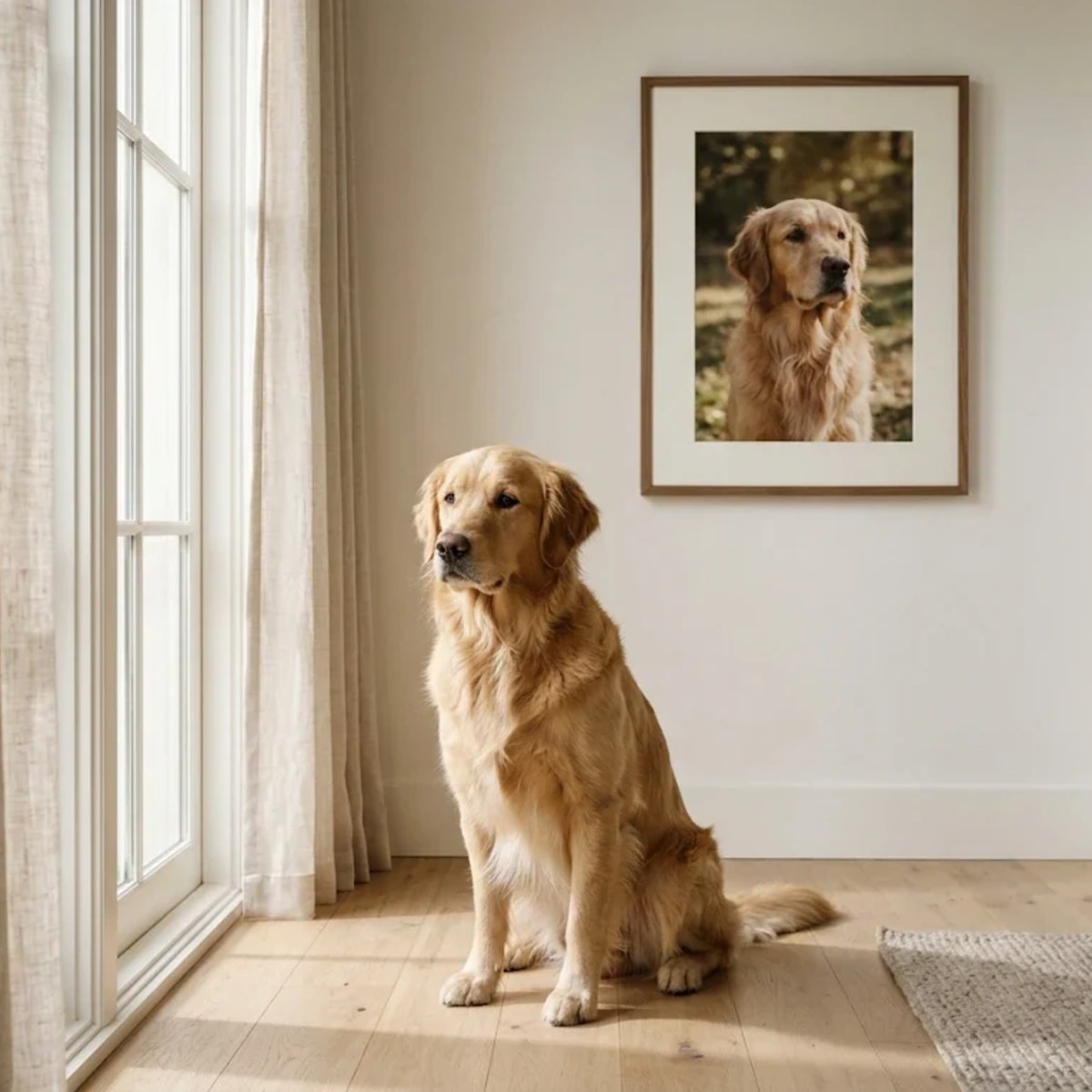
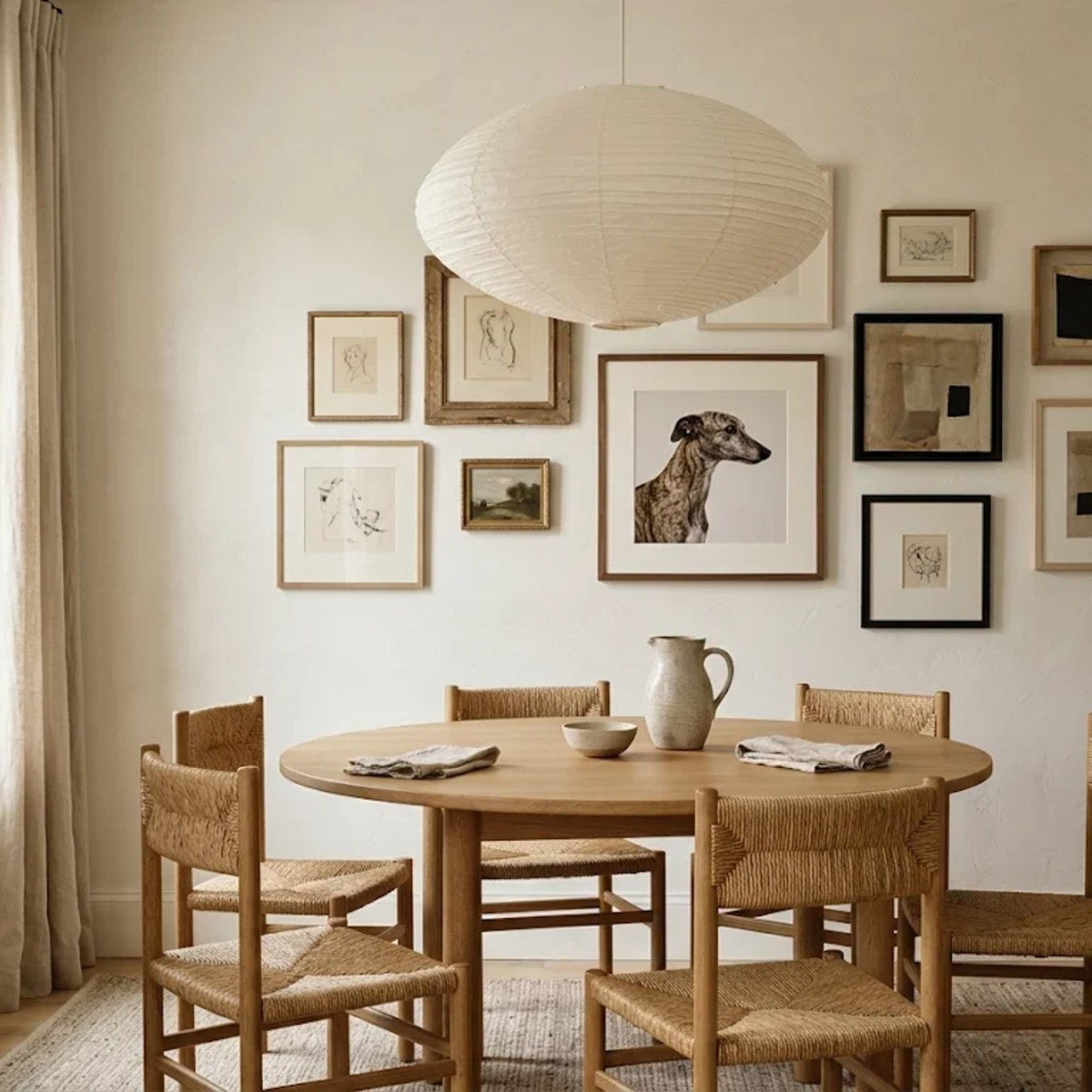
Canvas vs. Framed Pet Portraits: Which Lasts Longer?
Should you get your pet portrait on canvas or framed? A clear comparison of canvas prints and museum-grade framed portraits, and how to choose a pet print that will last.
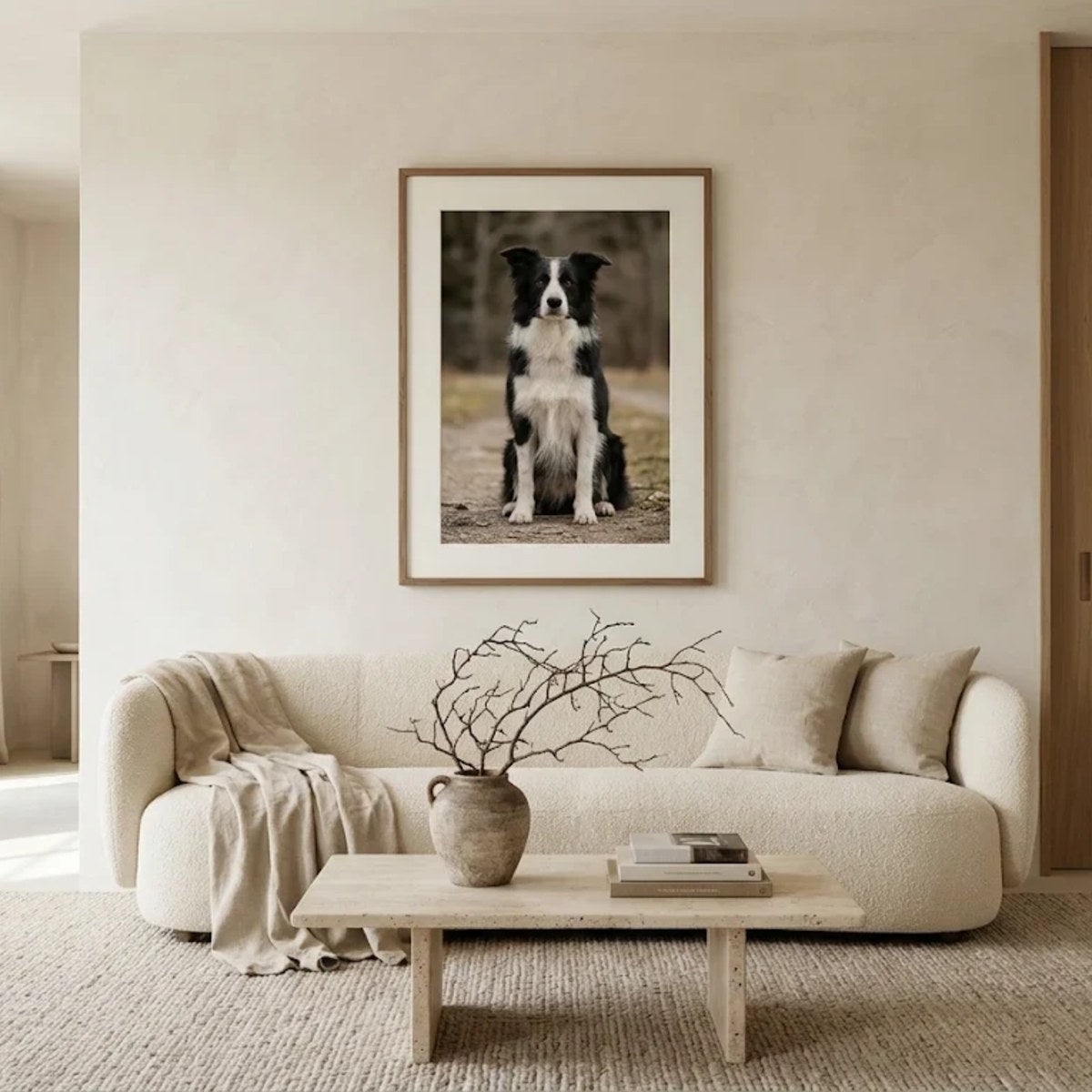
The short answer: if you want a pet portrait to look the same in twenty years, choose a framed print on archival cotton paper with pigment inks, a museum mat and glare-resistant acrylic. Canvas is a fine choice for casual, inexpensive wall art, but it's rarely made to archival standards and it leaves the image exposed.
Here's what actually separates the two, and what to check before you buy either.
Canvas vs. framed fine art, side by side
| Typical canvas print | Museum-grade framed portrait | |
|---|---|---|
| Surface | Textured fabric stretched over wood bars | 100% cotton fine-art paper, such as Hahnemühle Photo Rag |
| Detail | Weave texture softens fine detail like fur and whiskers | Smooth, deep tonal range that holds detail in black and white coats |
| Protection | Exposed to dust, touch and UV | Sealed behind glare-resistant acrylic |
| Presentation | No mat or frame | Optional museum mat and hand-finished frame |
| Longevity | Can sag, crack or fade, depending on materials | Built from archival, acid-free materials |
| Price | Usually lower | Higher, reflecting materials and hand finishing |
Why fine-art paper outperforms canvas for pet portraits
Dogs are hard to print well. Black coats lose detail in the shadows, white coats blow out in the highlights, and fur texture turns muddy on rough surfaces. Cotton rag papers are made for exactly this: they hold subtle shadow detail, give black fur real depth, and keep light coats from turning flat.
Archival papers are also acid-free and lignin-free, which means they don't yellow or break down the way standard paper does.
What "museum-grade" should actually mean
The phrase is used loosely, so look for the specific materials behind it:
- Archival pigment inks designed for long-term color stability
- 100% cotton rag paper that is acid-free and made for preservation
- A 4-ply museum mat that keeps the print from touching the glazing and gives the image room to breathe
- Glare-resistant acrylic instead of regular glass, so the portrait is visible in a bright room and protected from dust and UV
- A well-made frame, such as solid wood, that won't chip like plastic or composite moldings
Every Everframe portrait is made with these materials and inspected by experts before it ships. See the Everframe Standard.
When canvas makes sense
Canvas has its place. It's inexpensive, light, and works well in casual spaces like a kid's room or a beach house, where a relaxed, textured look suits the room. If longevity isn't the goal, it's a reasonable choice.
But for a portrait of a dog who's part of the family, especially a memorial, most people want something built to last.
Why canvas prints fade, sag and crack
Canvas isn't bad by nature, but most low-cost canvas prints are made in ways that shorten their life:
- No glazing. The image faces the room directly, so it collects dust, kitchen grease and fingerprints, and it gets the full dose of daylight.
- Dye-based inks. Many budget canvases use dye inks, which can fade noticeably in a bright room within a few years.
- Humidity. Cotton and poly-cotton canvas expands and contracts with the seasons. Over time it can loosen and sag on the frame.
- Wrapped edges. On a gallery wrap, part of the image folds around the sides. The folds are where coatings tend to crack first, and part of your photo ends up on the edge instead of the front.
A framed fine-art print avoids all four: the glazing protects the surface, pigment inks resist fading, the mat and backing keep the paper flat, and the whole image stays on the front.
The real cost over time
Canvas usually costs less up front. But a portrait of your dog isn't something you'll replace in three years. If a canvas fades or sags and you reprint it, or you later pay a framer to put it behind glass, the savings disappear quickly. Spread over the decades a well-made framed print lasts, it's often the less expensive choice. Our custom dog portrait price guide compares typical prices.
Can you put a canvas behind glass?
You can, using a deep frame or a shadow box, but it rarely looks right. Canvas is made to be seen without glazing, and its texture shows reflections unevenly. If you want protection, it's simpler to start with a print made for framing.
What about wood, metal and acrylic?
Canvas and framed paper are the two most common choices, but not the only ones. For how wood, metal and acrylic prints compare on detail, glare and longevity, see pet portraits on wood, canvas, metal or paper.
How to choose a pet print that lasts
- Start with the best original photo. Use the original file, not a screenshot or a version sent through a messaging app. Our photo guide explains what prints well.
- Ask what paper and inks are used. If a company can't name them, assume they aren't archival.
- Check the glazing. Glare-resistant acrylic beats standard glass for both visibility and protection.
- Choose the right scale. An 8×10 sits well on a shelf; a 16×20 can anchor a wall.
- Hang it out of direct sunlight, away from heat and humidity.
Frequently asked questions
Should I get my pet portrait on canvas or framed?
Framed, if you want it to last and to look refined in a well-designed room. Canvas is better suited to casual, short-term decor.
How do I choose quality pet photo prints that last?
Look for archival cotton paper, pigment inks, a museum mat and glare-resistant acrylic, and start from the highest-quality original photo you have.
Do framed portraits fade?
Archival pigment prints on cotton paper are designed to resist fading for many decades, especially behind UV-protective acrylic and away from direct sun.
Why does my canvas print look faded?
Most often it's daylight acting on dye-based inks with no glazing to block UV. Moving it out of direct sun slows it down, but faded canvas can't be restored.
Is canvas or framed better for a dog memorial?
Framed. A memorial is meant to last, and archival paper behind glare-resistant acrylic keeps the image as it is today. See pet memorial portraits from photos.
A different standard
There's nothing wrong with canvas. It's just built for a different purpose. If you want your dog's portrait to feel as considered as the rest of the art in your home, choose fine-art framing.
Explore Everframe's museum-grade framed portraits.
Chase Fritchle is the founder of Everframe.